
A great pair of glasses should do more than complete your look. It should feel comfortable, stay in place, and sit naturally on your face throughout the day.
Poorly fitting frames can cause slipping, pressure behind the ears, headaches, and constant readjustment. The good news is that most fit issues are easy to spot once you know what to look for.
Here are seven signs your glasses fit correctly, plus what different fit problems may be telling you.
1. The frame sits level across your face
Your glasses should appear balanced from side to side. One lens should not sit noticeably higher than the other, and the frame should not look twisted when viewed straight on.
A slight imbalance can sometimes be corrected with a professional adjustment. If the frame repeatedly tilts or sits unevenly, the temples may need adjustment or the frame may not match your head shape well.
2. Your eyes are positioned comfortably within the lenses
Your eyes do not need to sit perfectly in the mathematical center of every frame, especially with fashion-forward or oversized styles. However, they should look naturally positioned within the lens area rather than crowded near the top, bottom, or outer edges.
When your eyes appear far outside the visual center of the lenses, the frame may be too wide, too narrow, too tall, or sitting incorrectly on the bridge.
3. The bridge feels secure without pinching
The bridge is the part of the frame that rests on your nose. It should feel stable without creating sharp pressure or visible marks after normal wear.
If the bridge is too narrow, you may feel pinching or concentrated pressure. If it is too wide, the frame may slide down repeatedly. Bridge design matters as much as the printed bridge measurement. A keyhole bridge, saddle bridge, molded acetate bridge, and adjustable nose pads can all fit differently even when the listed measurement is similar.
4. The frame width matches your face
The outer edges of the frame should generally align with the widest part of your face without pressing into your temples or extending excessively beyond them.
Frames that are too narrow may bow outward at the temples, create side pressure, or leave marks near the ears. Frames that are too wide may shift when you move, slide down easily, or look visually disconnected from your facial proportions.
A slightly oversized fit can be intentional, but it should still feel secure and balanced.
5. The temples rest comfortably behind your ears
The temple arms should extend straight back and curve gently behind your ears. They should hold the frame in place without squeezing the sides of your head.
Pressure behind the ears may mean the temples are too short, too tight, or angled incorrectly. If the temples flare dramatically outward, the frame may be too narrow overall.
Some temple issues can be corrected by an optician, but a frame that is fundamentally too small may never feel fully comfortable.
6. The glasses stay in place during normal movement
Well-fitting glasses should remain reasonably secure when you walk, look down, or move your head naturally. A small amount of movement is normal, but constant slipping usually signals a fit issue.
Common causes include a bridge that is too wide, temples that are too loose, a frame that is too heavy in front, or nose pads that need adjustment.
Skin oils, heat, and humidity can also make glasses slide more easily, but a properly fitted frame should not require constant pushing back into place.
7. The frame does not rest heavily on your cheeks
Your glasses may lightly touch your cheeks when you smile, depending on your facial structure and the frame shape. However, they should not rest heavily on your cheeks during normal wear.
Frequent cheek contact can cause the frame to lift when you smile, leave marks, or create smudges on the lenses. This may happen when the frame is too tall, the bridge sits too low, or the lens shape does not suit your facial proportions.
What can be adjusted?
Many minor fit problems can be improved by an optician. Common adjustments include:
- tightening or loosening the temples
- adjusting the angle behind the ears
- aligning a crooked frame
- adjusting nose pads
- correcting minor frame tilt
However, adjustments cannot completely change the fundamental size or proportions of a frame. A frame that is significantly too wide, too narrow, or poorly matched to your bridge may still feel wrong after adjustment.
When the frame may be the wrong size
A different size or style may be a better choice if your glasses:
- cause persistent pressure at the temples
- slide down immediately after adjustment
- extend far beyond the sides of your face
- sit heavily on your cheeks
- place your eyes awkwardly within the lenses
- require constant readjustment throughout the day
Use a pair you already love as your reference
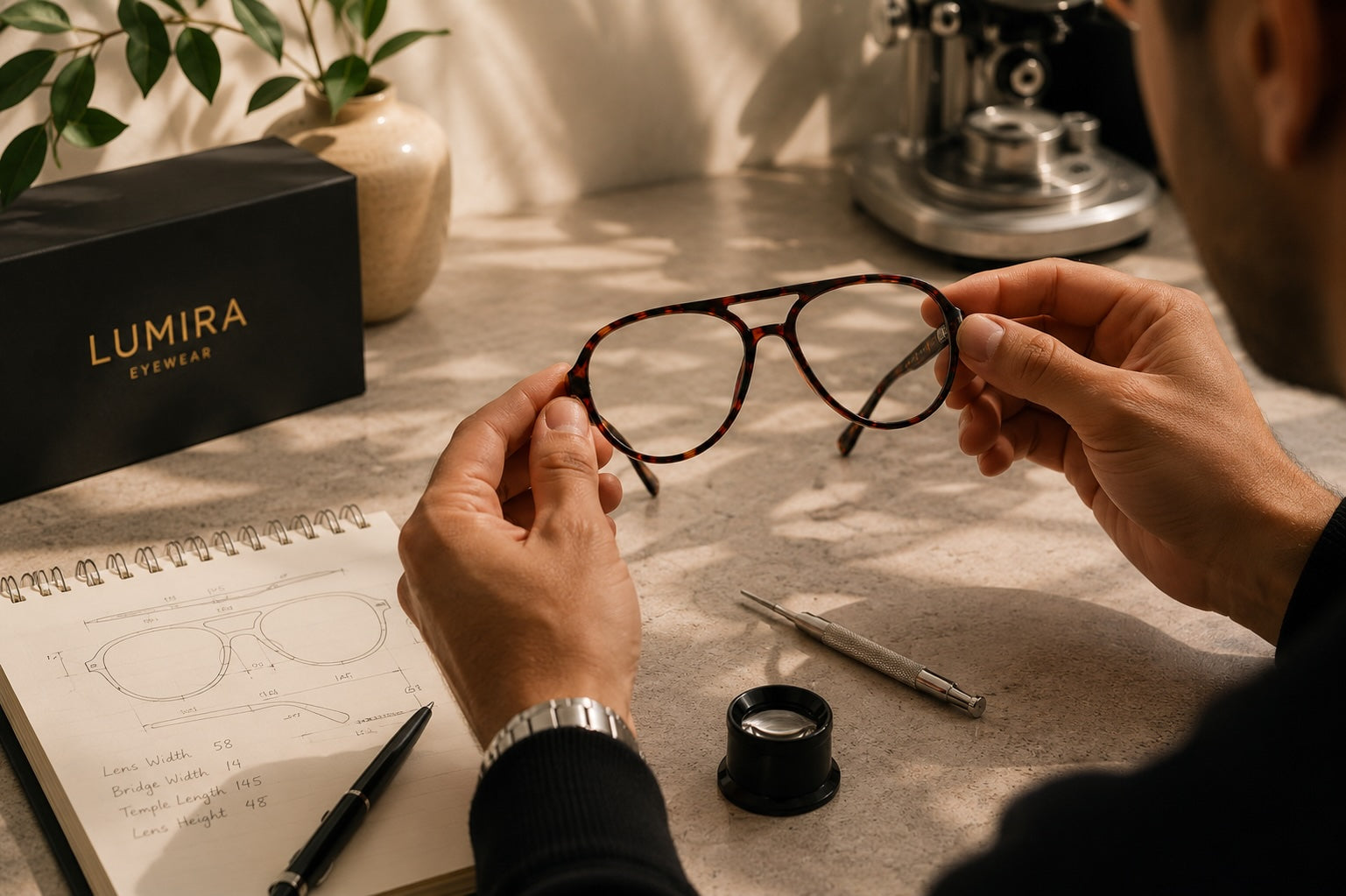
When buying eyewear online, start with a pair that already fits you well. Compare the total frame width, bridge style, temple length, lens height, and overall shape with the frame you are considering.
Printed measurements are useful, but they are only part of the fit story. Frame material, curvature, hinge placement, bridge construction, and lens shape all influence how a pair feels on your face.
Comfort should be part of the style
The right glasses should feel secure without feeling restrictive. They should complement your features, remain comfortable through everyday wear, and require minimal adjustment.
At Lumira Eyewear, we include frame measurements and practical fit guidance whenever available so you can compare styles more confidently before ordering.
Explore Lumira Eyewear and find a frame designed for comfortable, everyday wear.
